 Deutsch
  English (UK)
  Nederlands
  Español
  简体中文
简体中文 


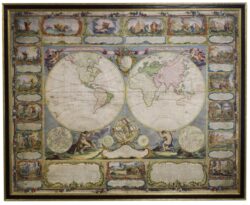


Wall map of the world in two hemispheres printed on two sheets,
| Autor | |
|---|---|
| Veröffentlichungsjahr | 1754 |
| Verlag | |
| Produktnummer | 12551 |
Wall map of the world in two hemispheres printed on two sheets, depicting the Eastern and Western hemispheres supported by two male figures, decorated at the bottom right and left with two celestial hemispheres (boreal and southern) and at the bottom in the middle with an armillary sphere, in addition. Size 115 x 145 cm.
The copper engraving was made by Gobert-Denis Chambon after the work of Guillaume De L’Isle, published in 1754 by Jean Janvier and S.G. Longschamps. This map is most notable for its depiction of the Sea of Japan labeled “Mer de Corée” and of “Mer de L’Ouest” or Sea of the West – a great sea, easily the size of the Mediterranean, to flow from the then-known Strait of Juan de Fuca. Australia and New Zealand are depicted in typical post-Tasman form, however, unlike other French cartographers at the time who tended to join New Guinea to Tasmania in a single and highly creative, imaginary coastline, Janvier leaves those undiscovered coastlines blank. Early Dutch discoveries are noted in Australia and New Zealand, as are other recent discoveries in the world.
The tracks of Magellan, Vasco da Gama, and Francis Drake are shown. According to Don McGuirk, this map shows an early copy of a Buache type 1 Mer de l’Ouest. Four states of this map were found. – State 1: Dated 1751. – State 2: Dated 1754. Under the title, engraved by “Chambon”. Lower left, “A PARIS, chés les Sieurs Longchamps et Janvier, Geographes, rue St Jacques a l’Enseigne de la Place des Victoires.” This state and later states is found surrounded by borders with biblical vignettes. – State 3: Dated 1788. Now “chez Mondhare and Jean”. – State 4: Dated An 8 (1799-1800). Now “Paris Chez Jean rue Jean de Beauvois. Reference: McGuirk, The Last Great Cartographic Myth – Mer de l’Ouest, 30. Later colored. Some parts are contemporarily underlaid with paper, for protective reasons. Repair of a split on the crossing of folds. Some paper discoloration. Some staining and folds.
A good copy of a rare wall map.

