 Nederlands
  English (UK)
  Deutsch
  Español
  简体中文
简体中文 


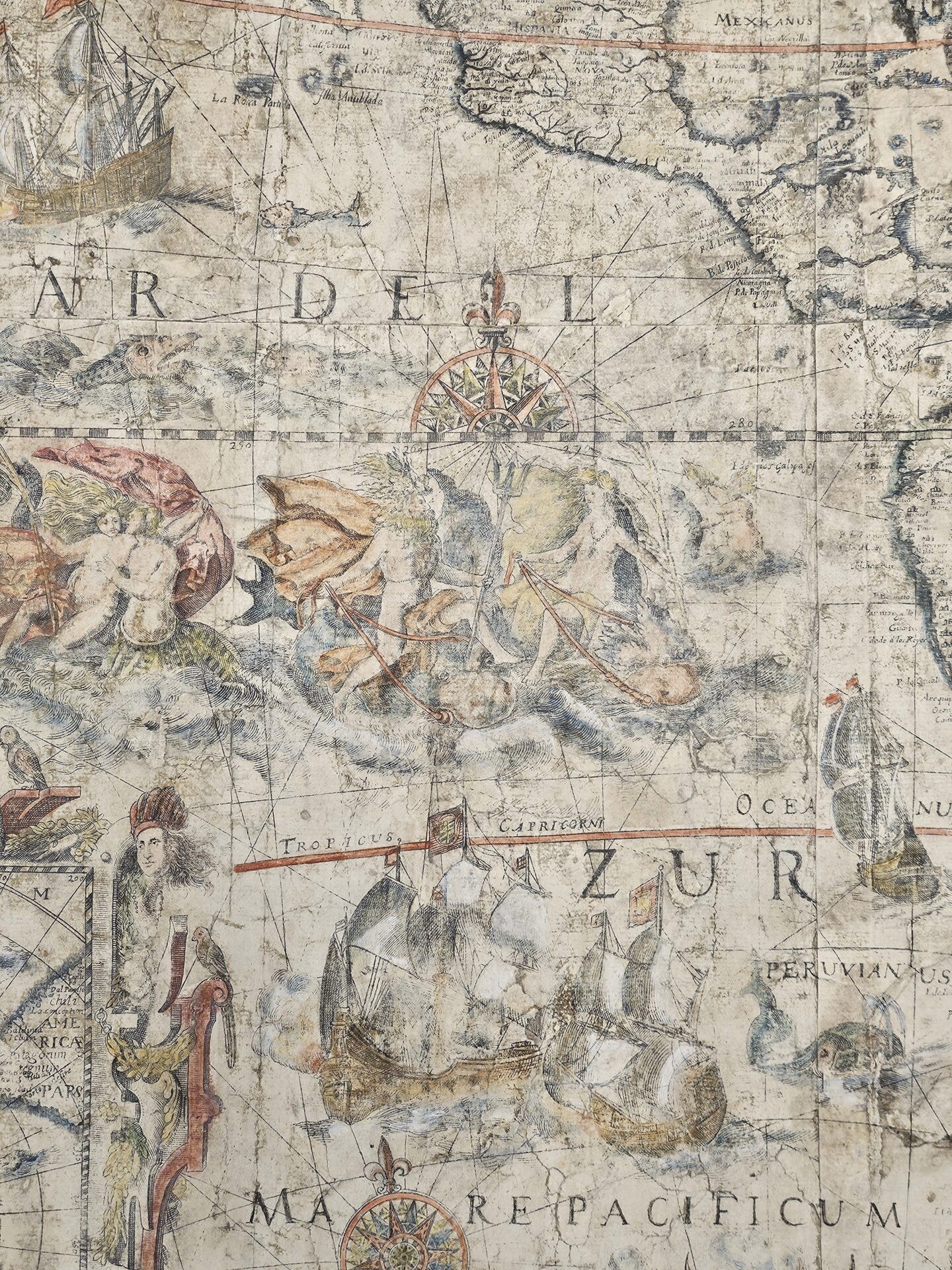


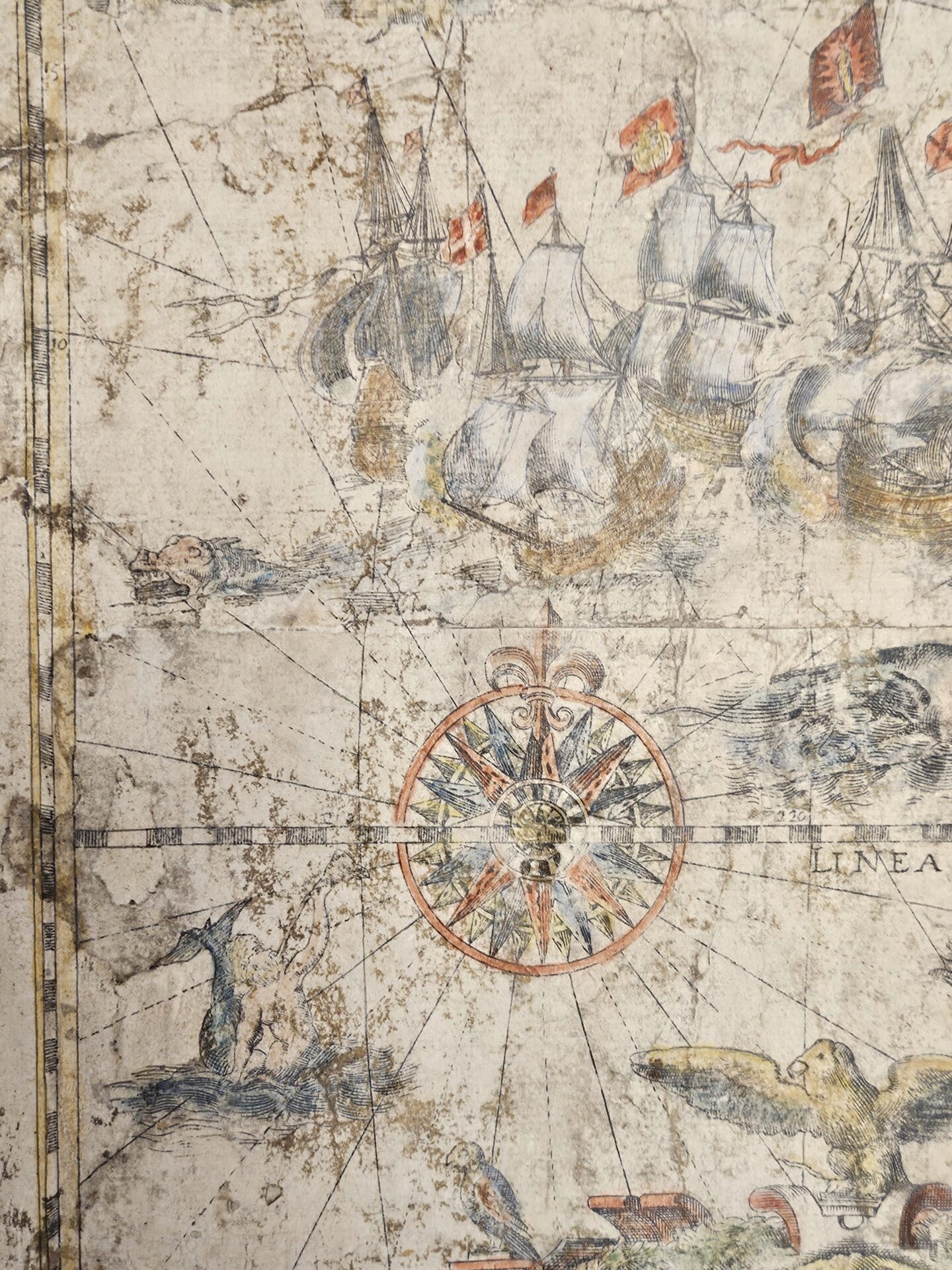




One of the most influential maps of America ever made.
| Auteur | |
|---|---|
| Jaar van Uitgave | 1673 |
| Uitgever | |
| Productnummer | 12722 |
A hand-coloured engraved wall map, printed on 4 joined sheets. Size: 86 x 110 cm. / 33.9 x 43,3 inch.
Large, very rare, hand coloured copy of Willem Blaeu’s famous wall map of the Americas, which is considered “one of the most influential maps of America ever made” (Burden).
The map is based on the latest explorations and shows everything known at the time about the American continent, as well as the north and south poles, which are included on two inset maps. As the wall map was in great demand, but expensive and difficult to transport, it was also printed by various French and Italian publishers for the local market. Like Blaeu’s edition, the French and Italian editions are very scarce, as it is highly unusual for wall maps from this period to survive. We have only been able to trace 4 other copies of the present edition in sales records of the past hundred years, of which only 1 is also hand coloured.
Willem Janszoon Blaeu (1571-1638) first published the wall map in 1608, together with similar maps of Asia, Africa, and Europe. He spared no expenses for this project and hired Hessel Gerritsz (1580-1632), a great cartographer in his own right, to both design the maps and research the latest sources exhaustively, to create the most accurate depiction of the continents possible. Although the Americas were drawn too wide due to the inadequate methods of determining longitude at the time, the shapes and most of the coastline are already very well defined. Central and South America were drawn according to Portuguese and Spanish sources, and “Nova Scotia” on the Atlantic coast was based on the voyages of Samuel de Champlain and Pierre Gua de Monts from 1604. After the first edition in 1608, the four continents were subsequently published in 1612, and in 1624 they were reissued by Hendrik Hondius and in 1655 by Nicholas Visscher. The third state included changes to the Strait of Magellan based on Le Maire’s findings from his expedition in 1615-1617.
The map has been beautifully decorated with cartouches and small engravings. The cartouche in the lower right tells how the New World was discovered, and is flanked by the figures of Christopher Columbus and Amerigo Vespucci. Below are four roundels containing the portraits of the four circumnavigators: Ferdinand Magellan, Sir Francis Drake, Sir Thomas Cavendish, and Olivier Van Noort. The Atlantic features a beautiful depiction of King Philip III of Spain riding a sea chariot, supposedly on a figurative visit to his New World possessions, and in the Pacific Poseidon with his wife Amphitrite and son Triton can be found, amidst battle ships and sea monsters. Elephants, rhinoceroses, camels, and ostriches roam the continent. Some copies of the present map include a decorative border with illustrations of native people, and sometimes also a textual border with descriptions, which are not present here. It appears that these borders were engraved on separate copper plates and were not always included.
Blaeu’s wall maps were first printed in Italy in 1646, probably by Stefano Mozzi Scolari (1598-1650) in Venice, which were based on the third state from 1624. The present copy was engraved by Pietro Todeschi (dates unknown) around 1670, and published in Bologna in 1673, probably by Giuseppe Longhi, who had worked on similar projects with Todeschi before. It closely resembles the Venetian edition, which was most likely used as the model. Todeschi’s edition is, however, clearly recognizable because of the misspelling of Mar del Norte as Mar del Noi, and the fact that California has been drawn as an island. It is the only edition known to do so. The map has been reinforced on the back, and is somewhat browned and stained; the surface has faded, the work has been professionally restored: the colouring has been retouched, some of the losses have been filled in. Otherwise, in good condition.
Burden II, 433; Schilder, Monumenta cartographica Neerlandica V, p. 195; cf. Burden I, 156 (Blaeu map).

